
YIFENG LENG (VAX)
M.F.A in Animation, SCAD, 2023

3D Animator | Modeler | Rigger


Global Game Jam - 2026


Awarded Best Use of Theme at SCAD Game Jam 2026
Our team won Best Use of Theme, and my contribution was making sure the characters visually and physically embodied that theme.
Through modeling, rigging, and animation, I focused on silhouettes, motion language, and performance beats so the theme wasn’t just in the story — it was visible in every movement.

Animation Demo Reel/ Project Breakdown of my workflow
Hide in Plain Trailer
About
In this party hide-and-seek game, one player is a spray-wielding cleaner, while the others are 2D creatures living inside wall paintings and doodles. What looks like dirt to one player is home to another.
Run across walls, slip around corners, and blend into the environment by turning into objects. Hide in plain sight, stay inside the paint, and avoid being wiped away.
It’s fast, chaotic, and a little bit unfair —
because getting cleaned was never part of the plan.
Credits:
Game Design/Program: Roy Zhang, Jingkun Ren.
2D Art: Zhuo Ma, Peter Wang.
3D Art/Animation: Yifeng Leng.
VFX: Tianli Shen
Composition: Tris Zhou
Music generated by Suno
Global Game Jam Link: https://globalgamejam.org/games/2026/project-mask-5

Role & Production Breakdown
Stage 01: Concepts and Design
What it is
The objective at this stage was to establish a clear visual direction for the main playable character that aligned with the overall art style of the project. This included defining character proportions, silhouette clarity, and the appropriate level of stylization prior to beginning 3D production.
My role
This stage involved gathering and analyzing visual references that matched the intended aesthetic direction of the game. In collaboration with Lead Artist Zhuo Ma, the character’s body proportion was defined as a 5-head-tall stylized ratio, balancing cartoon appeal with gameplay readability. A curated set of references, informed by film and game character design experience, was assembled to guide shape language, proportion consistency, and animation-friendly forms.
Problem solved
Early visual alignment reduced the risk of stylistic inconsistency and prevented proportion issues that could negatively impact animation and gameplay readability. Establishing clear proportion guidelines and targeted reference material ensured a strong silhouette, cohesive visual language, and a solid foundation for efficient modeling and rigging in later production stages.


Character Design Alignment & Reference Gathering
Role & Production Breakdown
Stage 02: 3D Modeling in ZBrush
What it is
The task at this stage was to translate the approved 2D design and proportion guidelines into a fully realized 3D character and props. The sculpt needed to capture the intended stylized form while remaining suitable for real-time game production.
My role
The character was sculpted in ZBrush based on the established reference set and proportion standards. Primary forms and secondary shapes were developed to preserve silhouette readability and personality.
Throughout the sculpting process, attention was given to maintaining clean, animation-friendly edge flow and avoiding unnecessary surface complexity. Form decisions were made with downstream rigging and deformation in mind, while keeping the overall polygon density efficient for game engine use.
Problem solved
A common risk in stylized sculpting is over-detailing or introducing complex forms that hinder deformation and optimization. By prioritizing strong primary shapes and controlled topology planning during sculpt development, the character maintained visual clarity while remaining efficient for retopology, rigging, and real-time performance.


Cleaner - Version 01

Cleaner - Final Version


Cleaner and The Spray
Role & Production Breakdown
Stage 03: Texturing and Rigging in Maya
What it is
At this stage, the goal was to prepare the character for animation by setting up materials and building a functional rig suitable for gameplay performance. The character needed to be animation-ready within a limited production timeframe.
My role
The sculpted character was brought into Maya for look setup and rigging.
Given the small scope of the project and the fast production schedule, materials were created using aiStandardSurface shaders directly in Maya, allowing for a clean and efficient real-time look without requiring a full UV unwrapping and texture painting pipeline.
For rigging, the character was built using Advanced Skeleton 5, enabling rapid creation of a production-ready control rig. After rig generation, deformation quality and control usability were tested to ensure the character could perform required gameplay animations smoothly and reliably.
Problem solved
In a 48-hour production environment, a full texture and UV workflow would have significantly increased production time without adding meaningful gameplay value. By using procedural material setups, the pipeline remained efficient while still achieving a clear visual read.
On the rigging side, using a proven rigging system allowed fast deployment of a stable control rig, reducing technical setup time and allowing more focus on animation performance. Ensuring clean deformation and functional controls early prevented animation issues later in production.

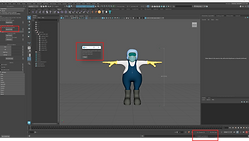


Character Rigging First Pass

Prop Rigging First Pass

Rig Test - Idle Cycle Animation
Role & Production Breakdown
Stage 04: 3D Animation
What it is
The task at this stage was to create a set of looping and action-based gameplay animations for the main playable character. These animations needed to respond clearly to player input and function reliably within a real-time gameplay system in Unreal Engine 5.
My role
A series of gameplay-driven animations were produced to support the character’s core interactions. These included:
-
Idle animation loop for default standing behavior
-
Jog cycle for player locomotion
-
Spray attack animation where the character raises the bottle and sprays disinfectant at surfaces
-
Nozzle switching animation to indicate a change in spray mode
Each animation was designed with clear posing, readable silhouettes, and strong timing to ensure the character’s actions were immediately understandable during gameplay. Loop transitions and motion arcs were kept clean to support seamless blending inside the engine’s animation state system.
Problem solved
Gameplay animation must prioritize clarity and responsiveness over subtle detail. Exaggerated poses and simplified motion arcs were used to ensure the character’s intentions remained readable from a gameplay camera distance.
Looping animations such as idle and jog required careful timing and contact consistency to prevent visible popping when repeating. Action animations were structured with clear anticipation and follow-through to provide visual feedback that matched player input, improving the overall feel of control.
By focusing on animation readability and engine-friendly looping, the character’s performance remained expressive while staying stable within the real-time system.


Animation Demo Reel

Animation Test in UE5
Final Reflection
This project demonstrated the importance of clear scope management and cross-disciplinary collaboration in a rapid production environment. Working within a 48-hour timeframe required prioritizing readability, performance, and pipeline efficiency over unnecessary detail.
The character pipeline — from visual alignment to in-engine animation delivery — emphasized decision-making that supported gameplay needs. Simplified material workflows, efficient rigging tools, and animation-focused modeling choices allowed the character to move from concept to playable within the limited schedule.
This experience reinforced the value of production-aware artistry, where visual quality, technical feasibility, and team communication must work together to achieve a functional and engaging result.
02/01/2026
VAX_EphoneLengYifeng